Science proved Albert Einstein’s theory about gravitational waves. The New Yorker published a fantastic article explaining it all. There’s something for everyone here:
Contrarians:
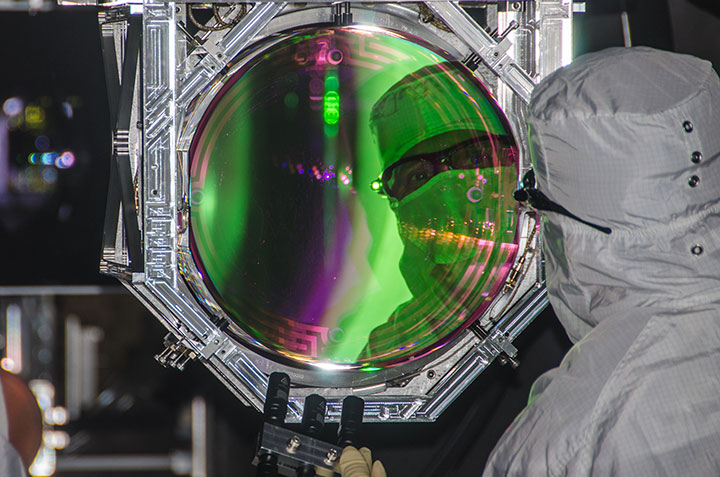
It took years to make the most sensitive instrument in history insensitive to everything that is not a gravitational wave.
Literalists:
“There are ten thousand other tiny things, and I really mean ten thousand,” Weiss said.
Script writers:
Word began to circulate among the thousand or so scientists involved in the project. In California, David Reitze, the executive director of the LIGO Laboratory, saw his daughter off to school and went to his office, at Caltech, where he was greeted by a barrage of messages. “I don’t remember exactly what I said,” he told me. “It was along these lines: ‘Holy shit, what is this?’ ” Vicky Kalogera, a professor of physics and astronomy at Northwestern University, was in meetings all day, and didn’t hear the news until dinnertime. “My husband asked me to set the table,” she said. “I was completely ignoring him, skimming through all these weird e-mails and thinking, What is going on?” Rainer Weiss, the eighty-three-year-old physicist who first suggested building LIGO, in 1972, was on vacation in Maine. He logged on, saw the signal, and yelled “My God!” loudly enough that his wife and adult son came running.
Simpletons & geniuses:
The theory, put simply, states that space and time curve in the presence of mass, and that this curvature produces the effect known as gravity.
Optimists & pessimists:
In their proposal, the LIGO team warned that their initial design was unlikely to detect anything. Nonetheless, they argued, an imperfect observatory had to be built in order to understand how to make a better one. “There was every reason to imagine this was going to fail,” Isaacson said. He persuaded the N.S.F. that, even if no signal was registered during the first phase, the advances in precision measurement that came out of it would likely be worth the investment. Ground was broken in early 1994.
Hackers:
To achieve the necessary precision of measurement, Weiss suggested using light as a ruler. He imagined putting a laser in the crook of the “L.” It would send a beam down the length of each tube, which a mirror at the other end would reflect back. The speed of light in a vacuum is constant, so as long as the tubes were cleared of air and other particles the beams would recombine at the crook in synchrony—unless a gravitational wave happened to pass through. In that case, the distance between the mirrors and the laser would change slightly. Since one beam would now be covering a shorter distance than its twin, they would no longer be in lockstep by the time they got back. The greater the mismatch, the stronger the wave. Such an instrument would need to be thousands of times more sensitive than any previous device, and it would require delicate tuning in order to extract a signal of vanishing weakness from the planet’s omnipresent din.
Six Sigma Superiorists:
Eventually, they confirmed that the detection met the statistical threshold of five sigma, the gold standard for declaring a discovery in physics. This meant that there was a probability of only one in 3.5 million that the signal was spotted by chance.
Musicians:
As it happens, the particular frequencies of the waves that LIGO can detect fall within the range of human hearing, between about thirty-five and two hundred and fifty hertz. The chirp was much too quiet to hear by the time it reached Earth, and LIGO was capable of capturing only two-tenths of a second of the black holes’ multibillion-year merger, but with some minimal audio processing the event sounds like a glissando. “Use the back of your fingers, the nails, and just run them along the piano from the lowest A up to middle C, and you’ve got the whole signal,” Weiss said.
Humans:
Just over a billion years ago, many millions of galaxies from here, a pair of black holes collided. They had been circling each other for aeons, in a sort of mating dance, gathering pace with each orbit, hurtling closer and closer. By the time they were a few hundred miles apart, they were whipping around at nearly the speed of light, releasing great shudders of gravitational energy. Space and time became distorted, like water at a rolling boil. In the fraction of a second that it took for the black holes to finally merge, they radiated a hundred times more energy than all the stars in the universe combined. They formed a new black hole, sixty-two times as heavy as our sun and almost as wide across as the state of Maine. As it smoothed itself out, assuming the shape of a slightly flattened sphere, a few last quivers of energy escaped. Then space and time became silent again.
Photo credit: LIGO